Question 151
Users are complaining that your Cloud Run-hosted website responds too slowly during traffic spikes. You want to provide a better user experience during traffic peaks. What should you do?
A. Read application configuration and static data from the database on application startup.
B. Package application configuration and static data into the application image during build time.
C. Perform as much work as possible in the background after the response has been returned to the user.
D. Ensure that timeout exceptions and errors cause the Cloud Run instance to exit quickly so a replacement instance can be started.
Question 152
You are a developer working on an internal application for payroll processing. You are building a component of the application that allows an employee to submit a timesheet, which then initiates several steps:
• An email is sent to the employee and manager, notifying them that the timesheet was submitted.
• A timesheet is sent to payroll processing for the vendor's API.
• A timesheet is sent to the data warehouse for headcount planning.
These steps are not dependent on each other and can be completed in any order. New steps are being considered and will be implemented by different development teams. Each development team will implement the error handling specific to their step. What should you do?
A. Deploy a Cloud Function for each step that calls the corresponding downstream system to complete the required action.
B. Create a Pub/Sub topic for each step. Create a subscription for each downstream development team to subscribe to their step's topic.
C. Create a Pub/Sub topic for timesheet submissions. Create a subscription for each downstream development team to subscribe to the topic.
D. Create a timesheet microservice deployed to Google Kubernetes Engine. The microservice calls each downstream step and waits for a successful response before calling the next step.
Question 153
You are designing an application that uses a microservices architecture. You are planning to deploy the application in the cloud and on-premises. You want to make sure the application can scale up on demand and also use managed services as much as possible. What should you do?
A. Deploy open source Istio in a multi-cluster deployment on multiple Google Kubernetes Engine (GKE) clusters managed by Anthos.
B. Create a GKE cluster in each environment with Anthos, and use Cloud Run for Anthos to deploy your application to each cluster.
C. Install a GKE cluster in each environment with Anthos, and use Cloud Build to create a Deployment for your application in each cluster.
D. Create a GKE cluster in the cloud and install open-source Kubernetes on-premises. Use an external load balancer service to distribute traffic across the two environments.
Question 154
You want to migrate an on-premises container running in Knative to Google Cloud. You need to make sure that the migration doesn't affect your application's deployment strategy, and you want to use a fully managed service. Which Google Cloud service should you use to deploy your container?
A. Cloud Run
B. Compute Engine
C. Google Kubernetes Engine
D. App Engine flexible environment
Question 155
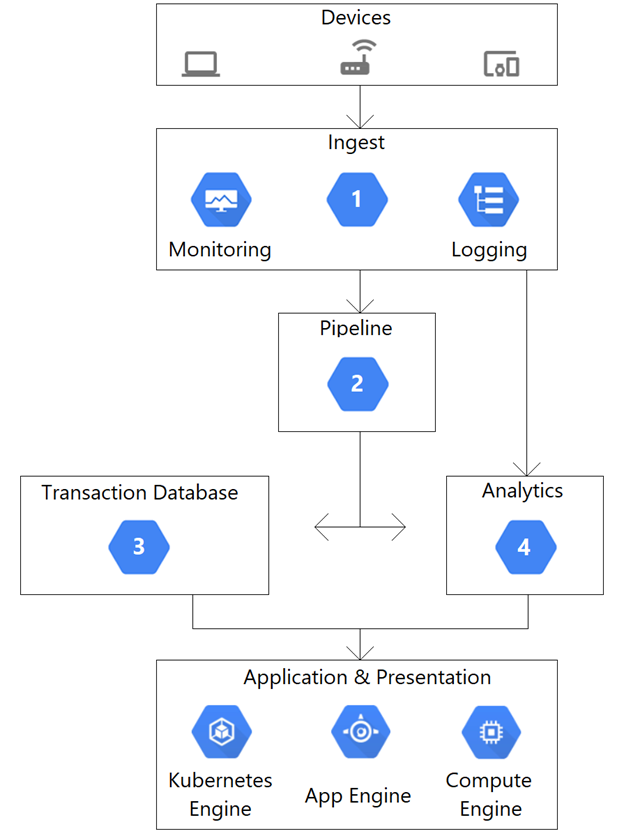
This architectural diagram depicts a system that streams data from thousands of devices. You want to ingest data into a pipeline, store the data, and analyze the data using SQL statements. Which Google Cloud services should you use for steps 1, 2, 3, and 4?
A. 1. App Engine
2. Pub/Sub
3. BigQuery
4. Firestore
B. 1. Dataflow
2. Pub/Sub
3. Firestore
4. BigQuery
C. 1. Pub/Sub
2. Dataflow
3. BigQuery
4. Firestore
D. 1. Pub/Sub
2. Dataflow
3. Firestore
4. BigQuery
Question 156
Your company just experienced a Google Kubernetes Engine (GKE) API outage due to a zone failure. You want to deploy a highly available GKE architecture that minimizes service interruption to users in the event of a future zone failure. What should you do?
A. Deploy Zonal clusters
B. Deploy Regional clusters
C. Deploy Multi-Zone clusters
D. Deploy GKE on-premises clusters
Question 157
Your team develops services that run on Google Cloud. You want to process messages sent to a Pub/Sub topic, and then store them. Each message must be processed exactly once to avoid duplication of data and any data conflicts. You need to use the cheapest and most simple solution. What should you do?
A. Process the messages with a Dataproc job, and write the output to storage.
B. Process the messages with a Dataflow streaming pipeline using Apache Beam's PubSubIO package, and write the output to storage.
C. Process the messages with a Cloud Function, and write the results to a BigQuery location where you can run a job to deduplicate the data.
D. Retrieve the messages with a Dataflow streaming pipeline, store them in Cloud Bigtable, and use another Dataflow streaming pipeline to deduplicate messages.
Question 158
You are running a containerized application on Google Kubernetes Engine. Your container images are stored in Container Registry. Your team uses CI/CD practices. You need to prevent the deployment of containers with known critical vulnerabilities. What should you do?
A. • Use Web Security Scanner to automatically crawl your application
• Review your application logs for scan results, and provide an attestation that the container is free of known critical vulnerabilities
• Use Binary Authorization to implement a policy that forces the attestation to be provided before the container is deployed
B. • Use Web Security Scanner to automatically crawl your application
• Review the scan results in the scan details page in the Cloud Console, and provide an attestation that the container is free of known critical vulnerabilities
• Use Binary Authorization to implement a policy that forces the attestation to be provided before the container is deployed
C. • Enable the Container Scanning API to perform vulnerability scanning
• Review vulnerability reporting in Container Registry in the Cloud Console, and provide an attestation that the container is free of known critical vulnerabilities
• Use Binary Authorization to implement a policy that forces the attestation to be provided before the container is deployed
D. • Enable the Container Scanning API to perform vulnerability scanning
• Programmatically review vulnerability reporting through the Container Scanning API, and provide an attestation that the container is free of known critical vulnerabilities
• Use Binary Authorization to implement a policy that forces the attestation to be provided before the container is deployed
Question 159
You have an on-premises application that authenticates to the Cloud Storage API using a user-managed service account with a user-managed key. The application connects to Cloud Storage using Private Google Access over a Dedicated Interconnect link. You discover that requests from the application to access objects in the Cloud Storage bucket are failing with a 403 Permission Denied error code. What is the likely cause of this issue?
A. The folder structure inside the bucket and object paths have changed.
B. The permissions of the service account’s predefined role have changed.
C. The service account key has been rotated but not updated on the application server.
D. The Interconnect link from the on-premises data center to Google Cloud is experiencing a temporary outage.
Question 160
You are using the Cloud Client Library to upload an image in your application to Cloud Storage. Users of the application report that occasionally the upload does not complete and the client library reports an HTTP 504 Gateway Timeout error. You want to make the application more resilient to errors. What changes to the application should you make?
A. Write an exponential backoff process around the client library call.
B. Write a one-second wait time backoff process around the client library call.
C. Design a retry button in the application and ask users to click if the error occurs.
D. Create a queue for the object and inform the users that the application will try again in 10 minutes.
