You recently developed an application that monitors a large number of stock prices. You need to configure Pub/Sub to receive messages and update the current stock price in an in-memory database. A downstream service needs the most up-to-date prices in the in-memory database to perform stock trading transactions. Each message contains three pieces or information: • Stock symbol • Stock price • Timestamp for the update How should you set up your Pub/Sub subscription?
Question 272
You are a developer at a social media company. The company runs their social media website on-premises and uses MySQL as a backend to store user profiles and user posts. Your company plans to migrate to Google Cloud, and your learn will migrate user profile information to Firestore. You are tasked with designing the Firestore collections. What should you do?
Question 273
Your team recently deployed an application on Google Kubernetes Engine (GKE). You are monitoring your application and want to be alerted when the average memory consumption of your containers is under 20% or above 80%. How should you configure the alerts?
Question 274
You manage a microservice-based ecommerce platform on Google Cloud that sends confirmation emails to a third-party email service provider using a Cloud Function. Your company just launched a marketing campaign, and some customers are reporting that they have not received order confirmation emails. You discover that the services triggering the Cloud Function are receiving HTTP 500 errors. You need to change the way emails are handled to minimize email loss. What should you do?
Question 275
You have a web application that publishes messages to Pub/Sub. You plan to build new versions of the application locally and need to quickly test Pub/Sub integration for each new build. How should you configure local testing?
Question 276
You recently developed an application that monitors a large number of stock prices. You need to configure Pub/Sub to receive a high volume messages and update the current stock price in a single large in-memory database. A downstream service needs the most up-to-date prices in the in-memory database to perform stock trading transactions. Each message contains three pieces or information: • Stock symbol • Stock price • Timestamp for the update How should you set up your Pub/Sub subscription?
Question 277
Your team has created an application that is hosted on a Google Kubemetes Engine (GKE) cluster. You need to connect the application to a legacy REST service that is deployed in two GKE clusters in two different regions. You want to connect your application to the legacy service in a way that is resilient and requires the fewest number of steps. You also want to be able to run probe-based health checks on the legacy service on a separate port. How should you set up the connection? (Choose two.)
Question 278
You are monitoring a web application that is written in Go and deployed in Google Kubernetes Engine. You notice an increase in CPU and memory utilization. You need to determine which function is consuming the most CPU and memory resources. What should you do?
Question 279
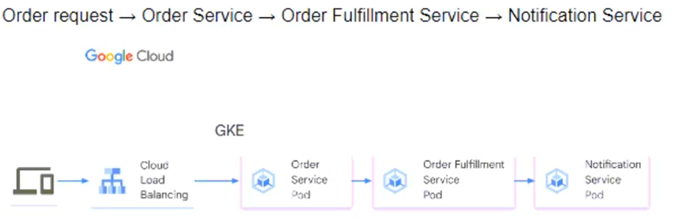
You are developing a flower ordering application. Currently you have three microservices: • Order Service (receives the orders) • Order Fulfillment Service (processes the orders) • Notification Service (notifies the customer when the order is filled) You need to determine how the services will communicate with each other. You want incoming orders to be processed quickly and you need to collect order information for fulfillment. You also want to make sure orders are not lost between your services and are able to communicate asynchronously. How should the requests be processed?
Question 280
You recently deployed an application to GKE where Pods are writing files to a Compute Engine persistent disk. You have created a PersistentVolumeClaim (PVC) and a PersistentVolume (PV) object on Kubernetes for the disk, and you reference the PVC in the deployment manifest file. You recently expanded the size of the persistent disk because the application has used up almost all of the disk space. You have logged on to one of the Pods, and you notice that the disk expansion is not visible in the container file system. What should you do?