You have deployed a Java application to Cloud Run. Your application requires access to a database hosted on Cloud SQL. Due to regulatory requirements, your connection to the Cloud SQL instance must use its internal IP address. How should you configure the connectivity while following Google-recommended best practices?
Question 242
Your application stores customers’ content in a Cloud Storage bucket, with each object being encrypted with the customer's encryption key. The key for each object in Cloud Storage is entered into your application by the customer. You discover that your application is receiving an HTTP 4xx error when reading the object from Cloud Storage. What is a possible cause of this error?
Question 243
You have two Google Cloud projects, named Project A and Project B. You need to create a Cloud Function in Project A that saves the output in a Cloud Storage bucket in Project B. You want to follow the principle of least privilege. What should you do?
Question 244
A governmental regulation was recently passed that affects your application. For compliance purposes, you are now required to send a duplicate of specific application logs from your application’s project to a project that is restricted to the security team. What should you do?
Question 245
You plan to deploy a new Go application to Cloud Run. The source code is stored in Cloud Source Repositories. You need to configure a fully managed, automated, continuous deployment pipeline that runs when a source code commit is made. You want to use the simplest deployment solution. What should you do?
Question 246
Your team has created an application that is hosted on a Google Kubernetes Engine (GKE) cluster. You need to connect the application to a legacy REST service that is deployed in two GKE clusters in two different regions. You want to connect your application to the target service in a way that is resilient. You also want to be able to run health checks on the legacy service on a separate port. How should you set up the connection? (Choose two.)
Question 247
You have an application running in a production Google Kubernetes Engine (GKE) cluster. You use Cloud Deploy to automatically deploy your application to your production GKE cluster. As part of your development process, you are planning to make frequent changes to the application’s source code and need to select the tools to test the changes before pushing them to your remote source code repository. Your toolset must meet the following requirements: • Test frequent local changes automatically. • Local deployment emulates production deployment. Which tools should you use to test building and running a container on your laptop using minimal resources?
Question 248
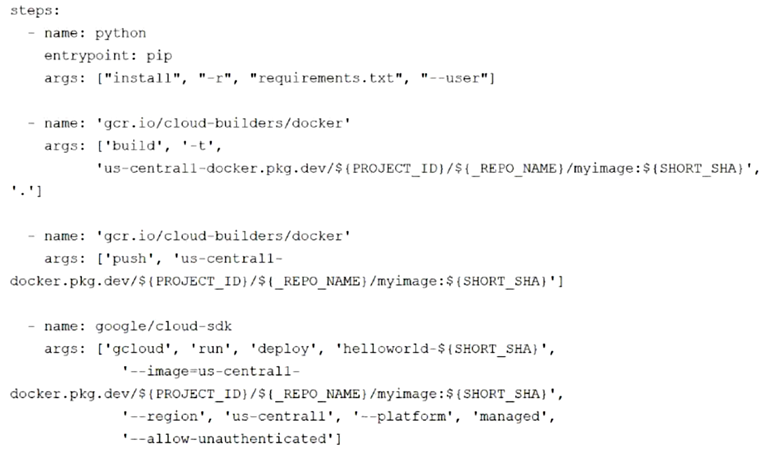
You are deploying a Python application to Cloud Run using Cloud Source Repositories and Cloud Build. The Cloud Build pipeline is shown below: You want to optimize deployment times and avoid unnecessary steps. What should you do?
Question 249
You are developing an event-driven application. You have created a topic to receive messages sent to Pub/Sub. You want those messages to be processed in real time. You need the application to be independent from any other system and only incur costs when new messages arrive. How should you configure the architecture?
Question 250
You have an application running on Google Kubernetes Engine (GKE). The application is currently using a logging library and is outputting to standard output. You need to export the logs to Cloud Logging, and you need the logs to include metadata about each request. You want to use the simplest method to accomplish this. What should you do?