You have been tasked with planning the migration of your company's application from on-premises to Google Cloud. Your company's monolithic application is an ecommerce website. The application will be migrated to microservices deployed on Google Cloud in stages. The majority of your company's revenue is generated through online sales, so it is important to minimize risk during the migration. You need to prioritize features and select the first functionality to migrate. What should you do?
Question 122
Your team develops services that run on Google Kubernetes Engine. Your team's code is stored in Cloud Source Repositories. You need to quickly identify bugs in the code before it is deployed to production. You want to invest in automation to improve developer feedback and make the process as efficient as possible. What should you do?
Question 123
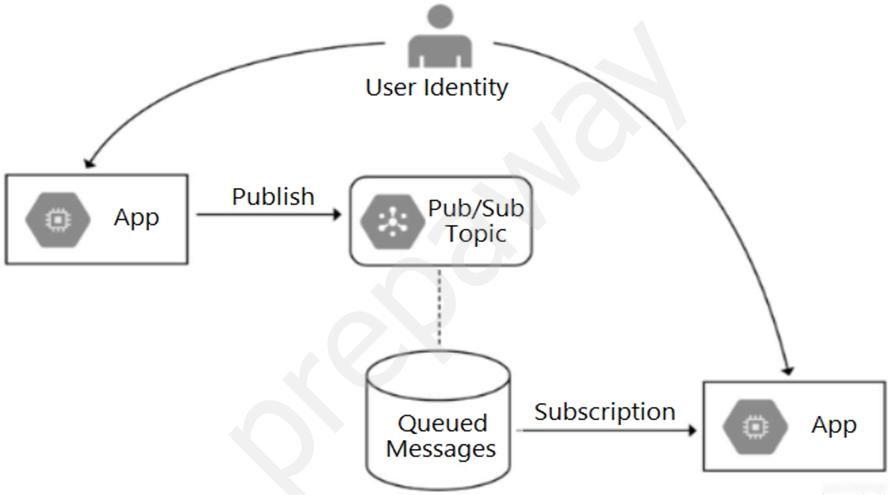
Your team is developing an application in Google Cloud that executes with user identities maintained by Cloud Identity. Each of your application's users will have an associated Pub/Sub topic to which messages are published, and a Pub/Sub subscription where the same user will retrieve published messages. You need to ensure that only authorized users can publish and subscribe to their own specific Pub/Sub topic and subscription. What should you do?
Question 124
You are evaluating developer tools to help drive Google Kubernetes Engine adoption and integration with your development environment, which includes VS Code and IntelliJ. What should you do?
Question 125
You are developing an ecommerce web application that uses App Engine standard environment and Memorystore for Redis. When a user logs into the app, the application caches the user's information (e.g., session, name, address, preferences), which is stored for quick retrieval during checkout. While testing your application in a browser, you get a 502 Bad Gateway error. You have determined that the application is not connecting to Memorystore. What is the reason for this error?
Question 126
Your team develops services that run on Google Cloud. You need to build a data processing service and will use Cloud Functions. The data to be processed by the function is sensitive. You need to ensure that invocations can only happen from authorized services and follow Google-recommended best practices for securing functions. What should you do?
Question 127
You are deploying your applications on Compute Engine. One of your Compute Engine instances failed to launch. What should you do? (Choose two.)
Question 128
Your web application is deployed to the corporate intranet. You need to migrate the web application to Google Cloud. The web application must be available only to company employees and accessible to employees as they travel. You need to ensure the security and accessibility of the web application while minimizing application changes. What should you do?
Question 129
You have an application that uses an HTTP Cloud Function to process user activity from both desktop browser and mobile application clients. This function will serve as the endpoint for all metric submissions using HTTP POST. Due to legacy restrictions, the function must be mapped to a domain that is separate from the domain requested by users on web or mobile sessions. The domain for the Cloud Function is https://fn.example.com. Desktop and mobile clients use the domain https://www.example.com. You need to add a header to the function's HTTP response so that only those browser and mobile sessions can submit metrics to the Cloud Function. Which response header should you add?
Question 130
You have an HTTP Cloud Function that is called via POST. Each submission's request body has a flat, unnested JSON structure containing numeric and text data. After the Cloud Function completes, the collected data should be immediately available for ongoing and complex analytics by many users in parallel. How should you persist the submissions?